NFV ETSI architecture and components
The European Telecommunications Standards Institute (ETSI) is an independent standardization group that develops standards for information and communications technologies (ICT) in Europe.
Network functions virtualization (NFV) focuses on addressing problems involved in using proprietary hardware devices. With NFV, the necessity to install network-specific equipment is reduced, depending upon the use case requirements and economic benefits. The ETSI Industry Specification Group for Network Functions Virtualization (ETSI ISG NFV) sets the requirements, reference architecture, and the infrastructure specifications necessary to ensure virtualized functions are supported.
Red Hat is offering an open source based cloud-optimized solution to help the Communication Service Providers (CSP) to achieve IT and network convergence. Red Hat adds NFV features such as single root I/O virtualization (SR-IOV) and Open vSwitch with Data Plane Development Kit (OVS-DPDK) to Red Hat OpenStack Services on OpenShift (RHOSO) environments.
Certain architectural characteristics and components define a network functions virtualization (NFV) environment.
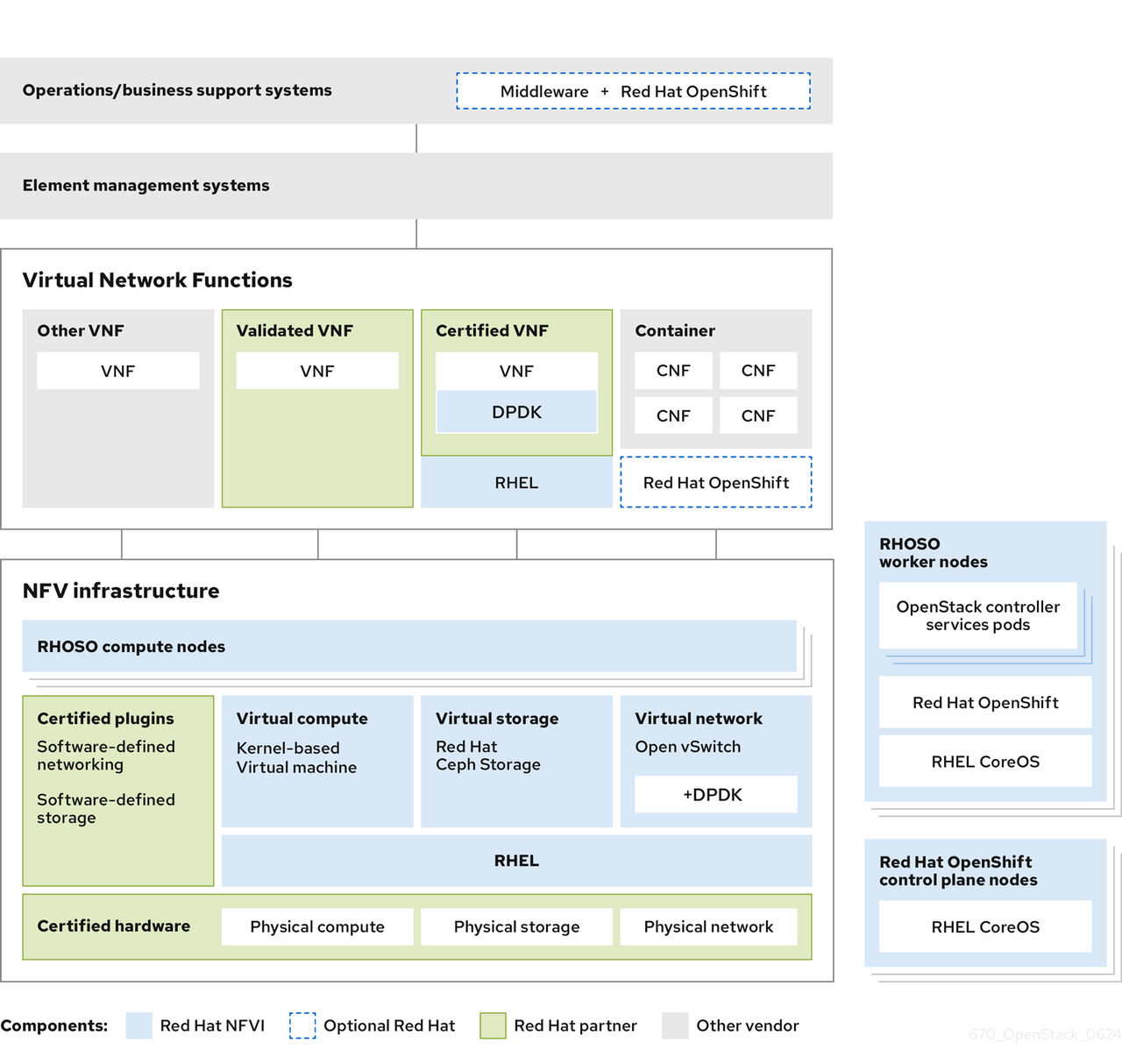
- Virtualized Network Functions (VNFs) - the software implementation of routers, firewalls, load balancers, broadband gateways, mobile packet processors, servicing nodes, signalling, location services, and other network functions.
- NFV Infrastructure (NFVi) - the physical resources (compute, storage, network) and the virtualization layer that make up the infrastructure. The network includes the data path for forwarding packets between virtual machines and across hosts. This allows you to install VNFs without being concerned about the details of the underlying hardware. NFVi forms the foundation of the NFV stack. NFVi supports multi-tenancy and is managed by the Virtual Infrastructure Manager (VIM). Enhanced Platform Awareness (EPA) improves the virtual machine packet forwarding performance (throughput, latency, jitter) by exposing low-level CPU and NIC acceleration components to the VNF.
- NFV Management and Orchestration (MANO) - the management and orchestration layer focuses on all the service management tasks required throughout the life cycle of the VNF. The main goals of MANO is to allow service definition, automation, error-correlation, monitoring, and life-cycle management of the network functions offered by the operator to its customers, decoupled from the physical infrastructure. This decoupling requires additional layers of management, provided by the Virtual Network Function Manager (VNFM). VNFM manages the life cycle of the virtual machines and VNFs by either interacting directly with them or through the Element Management System (EMS) provided by the VNF vendor. The other important component defined by MANO is the Orchestrator, also known as NFVO. NFVO interfaces with various databases and systems including Operations/Business Support Systems (OSS/BSS) on the top and the VNFM on the bottom. If the NFVO wants to create a new service for a customer, it asks the VNFM to trigger the instantiation of a VNF, which might result in multiple virtual machines.
- Operations and Business Support Systems (OSS/BSS) - provides the essential business function applications, for example, operations support and billing. The OSS/BSS needs to be adapted to NFV, integrating with both legacy systems and the new MANO components. The BSS systems set policies based on service subscriptions and manage reporting and billing.
- Systems Administration, Automation and Life-Cycle Management - manages system administration, automation of the infrastructure components and life cycle of the NFVi platform.
Advantages of NFV
Speed, efficiency, and economy are a few of the advantages of implementing network functions virtualization (NFV) in a Red Hat OpenStack Services on OpenShift (RHOSO) environment.
Specifically, the advantages are:
- Accelerates the time-to-market by enabling you to quickly deploy and scale new networking services to address changing demands.
- Supports innovation by enabling service developers to self-manage their resources and prototype using the same platform that will be used in production.
- Addresses customer demands in hours or minutes instead of weeks or days, without sacrificing security or performance.
- Reduces capital expenditure because it uses commodity-off-the-shelf hardware instead of expensive tailor-made equipment.
- Uses streamlined operations and automation that optimize day-to-day tasks to improve employee productivity and reduce operational costs.

